Dong-A University Professor Park Sung-hyuk's Team Announces Successive Research Achievements in Sustainable Environmental Technology
Jan 19, 2026
Dong-A University (President Lee Hae-woo) announced that four research papers in the field of environmental engineering led by Professor Park Sung-hyuk's research team (Department of Construction Systems Engineering/Department of ICT Convergence Marine Smart City Engineering) have been published in world-class SCI journals in succession, internationally proving the university's research competitiveness in the fields of environment and urban infrastructure.
The results of this research were published in the Journal of Environmental Chemical Engineering, Environmental Technology & Innovation, Journal of Environmental Management, and Water, Air, & Soil Pollution, published by the global academic publisher Elsevier.
The review paper "Enhancing municipal solid waste stabilization through sustainable aerobic landfill technologies," published in the Journal of Environmental Management by Professor Park Sung-hyuk's team, achieved the result of presenting a technology roadmap for reducing greenhouse gases and odors from landfills.
This study began from the perspective that preventing the generation of methane gas at its source—which has a much stronger greenhouse effect than carbon dioxide—may be more environmentally and comprehensively advantageous than utilizing it as an energy source after the fact. The research team systematically analyzed 'Aerobic Bioreactor Landfill' technology and comprehensively presented operational strategies and future research directions to reduce methane gas emissions from landfills and shorten the waste stabilization period.
Professor Park's research team also presented a technology that can dramatically extend the lifespan of landfills.
The paper, titled "Oxygenated Leachate Recirculation for Enhanced MSW Stabilization and Landfill Space Reclamation: Lab-Scale Bioreactor Insights," published by the team in the journal Water, Air, & Soil Pollution, showed that recirculating landfills with oxygen dissolved in extremely contaminated leachate resulted in greater subsidence of the landfill space compared to existing operating conditions.
This demonstrates that the lifespan of existing landfills can be extended by more than 20% by securing landfill space. The technology proposed in this study is expected to be utilized as an innovative landfill management solution that accelerates landfill stabilization while maximizing the utilization of existing landfills.
In addition, the first paper published in the Journal of Environmental Chemical Engineering, 'Biochar-assisted aerobic granulation in enhanced biological treatment of landfill leachate with municipal wastewater: A biorefinery approach,' revealed the potential for innovation in wastewater treatment and landfills.
The research team presented a technology that simultaneously treats landfill leachate and urban sewage by producing 'biochar (carbon-based functional material)' from waste sludge generated after sewage treatment. Furthermore, they achieved the feat of realizing the concept of 'biorefinery,' which converts sludge into liquid fuel (Bio-Oil) to simultaneously achieve wastewater treatment and resource recovery.
The second paper published in the Journal of Environmental Technology and Innovation, titled 'Valorization of waste mussel shells and spent coffee grounds into calcium-rich biochar for sustainable phosphate recovery for soil amendment,' draws attention for utilizing waste mussel shells and coffee grounds as eco-friendly materials.
The research team synthesized a calcium oxide-rich biochar complex by pyrolyzing discarded mussel shells and coffee grounds, and demonstrated excellent performance in adsorbing up to 375.6 mg/g of phosphate, which causes underwater eutrophication. In addition, by recycling the biochar into fertilizer and improving radish growth by more than 63%, they demonstrated the practical potential of circular economy-based environmental technology.
"Professor Park Seong-hyeok said, 'The core goals of this research are to drastically extend the lifespan of landfills and turn waste into resources,' adding, 'The results of this research present a practical and eco-friendly solution that can simultaneously address urban environmental and waste issues.'"
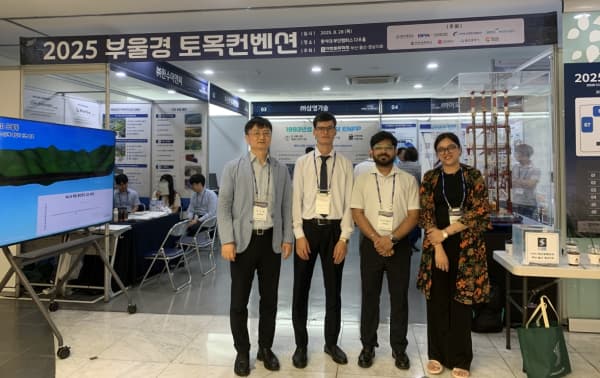
Professor Park Sung-hyuk, Dr. Arnab Ghosh, Dr. Tanushree Paul, and master's student Eraliev Javokhirbek participated in this research.
출처 : 교수신문(https://www.kyosu.net)